
How Much Does a Retaining Wall Cost in Oregon? 2026 Guide
Retaining wall costs in Oregon vary significantly based on wall material, height, site access, and how much grading and drainage work the slope requires before construction begins. The final investment depends on your specific project scope and site conditions.
That range is wide because retaining walls vary enormously in scope. A 20-foot-long, 2-foot-tall timber wall to level a garden bed is a fundamentally different project from a 50-foot-long, 5-foot-tall engineered block wall holding back a hillside. Below is a detailed breakdown of what drives the cost for each material type, the Oregon-specific factors that affect your project, and how to plan your budget accurately. Contact us for a free estimate with exact pricing for your property.
Retaining Wall Cost by Material
Material selection is the single largest cost variable. Each option has different structural capabilities, aesthetic appeal, and longevity in Oregon's wet climate. Here is how each material compares.
Concrete Block (Segmental Retaining Wall)
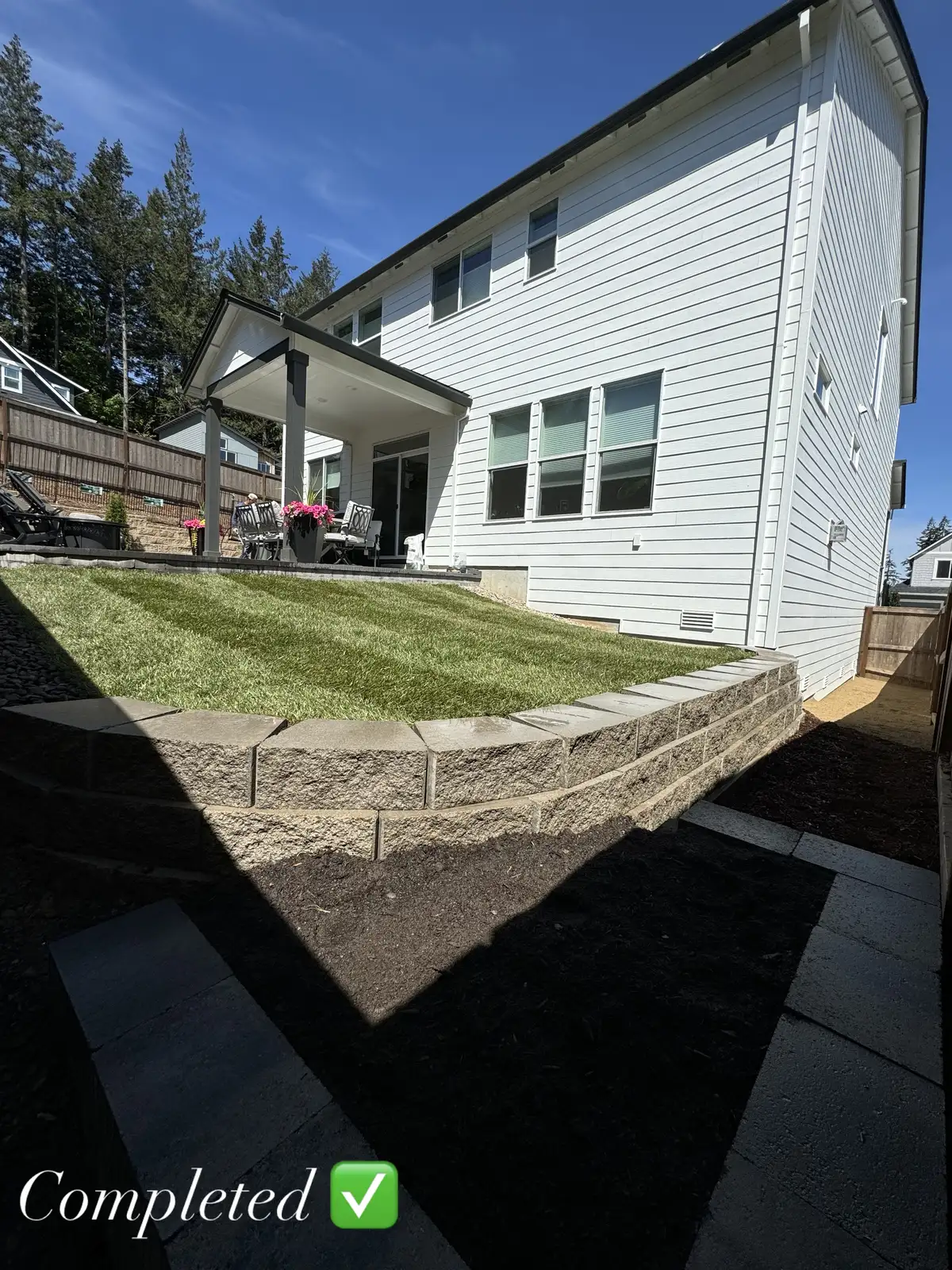
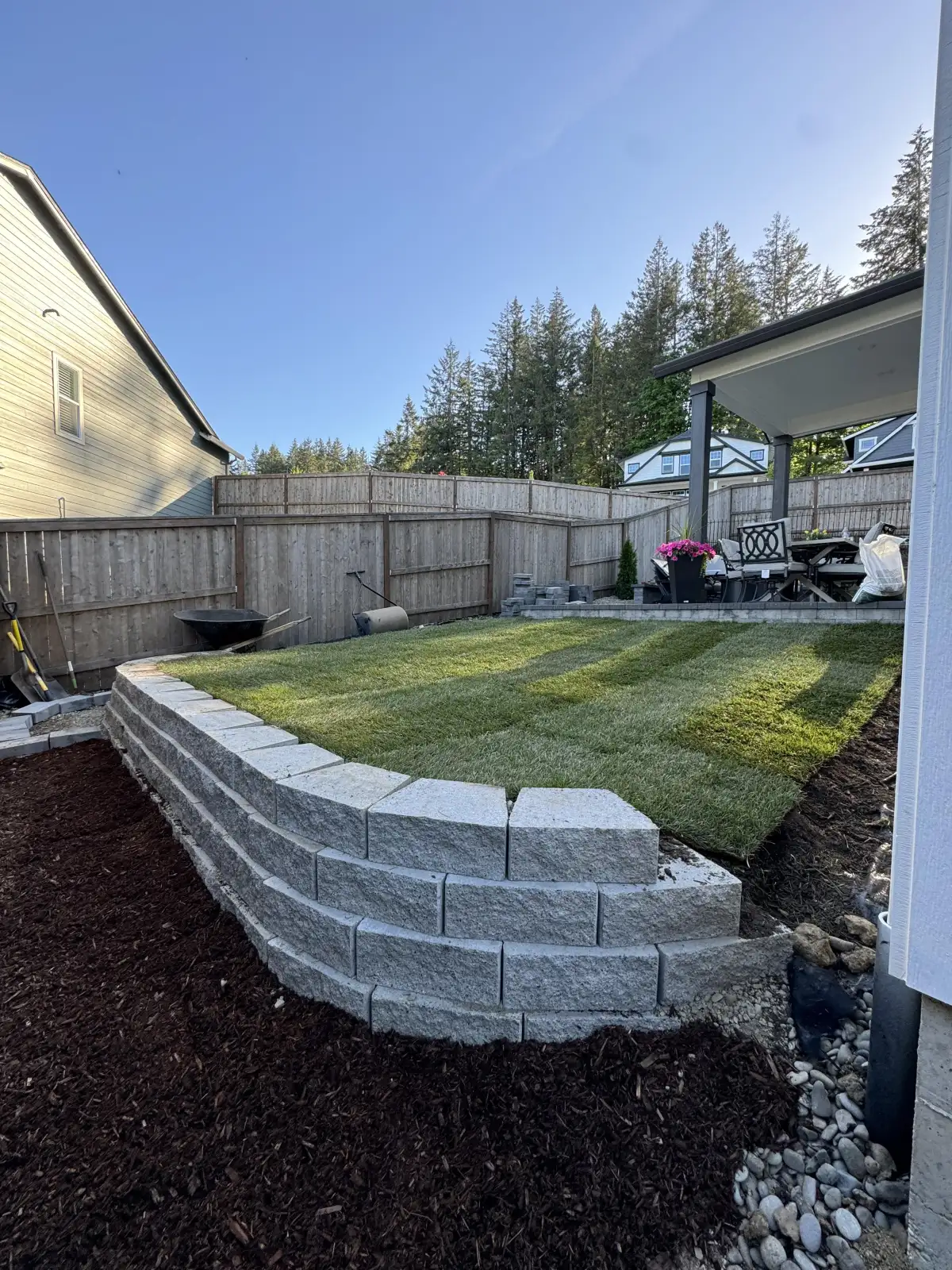
Concrete block is the most popular retaining wall material in Oregon for good reason. Interlocking segmental blocks are engineered for structural performance, handle Oregon's freeze-thaw cycles without cracking, and offer a clean, modern look that complements most residential landscape designs.
- Cost range: Most affordable of the engineered wall options
- Lifespan: 50 to 75 years
- Best for: Most residential projects — combines structural performance with reasonable cost
Block walls use a setback design where each course steps back slightly from the one below, creating inherent structural stability. For walls over 4 feet tall, geogrid reinforcement layers are tied into compacted backfill at regular intervals to increase load capacity. Most manufacturers offer blocks in multiple colors and textures, including options that convincingly mimic natural stone at a significantly lower cost.
Natural Stone
Natural stone walls offer unmatched visual character. Each stone is unique, and the finished product ages beautifully in Oregon's damp climate, developing a moss-edged patina that many homeowners find appealing.
- Cost range: Premium option — highest material and labor costs
- Lifespan: 75 to 100+ years
- Best for: Homeowners who want unmatched visual character and maximum longevity
The higher installed cost reflects the labor intensity of natural stone work. Unlike uniform blocks, each stone must be individually selected, shaped, and placed for structural integrity and aesthetic balance. Basalt, granite, and quartzite are the most durable options for Oregon and are commonly sourced from quarries in the Willamette Valley and the Columbia River Gorge.
Timber (Pressure-Treated or Railroad Tie)
Timber is the most affordable retaining wall option and works well for low walls (under 3 feet) where structural demands are modest. Pressure-treated landscape timbers (typically 6x6 or 8x8) are the standard choice.
- Cost range: Most budget-friendly option
- Lifespan: 15 to 25 years
- Best for: Low walls under 3 feet where budget is the primary concern
The major trade-off with timber in Oregon is longevity. Even pressure-treated wood eventually deteriorates in the Willamette Valley's wet climate. Expect visible wear after 10 to 15 years and potential structural replacement at the 20-year mark. Railroad ties are less expensive but contain creosote, which is increasingly restricted near waterways and garden beds in Oregon.
Poured Concrete
Poured concrete walls are the strongest structural option and are typically used where maximum load-bearing capacity is required — such as below-grade walls, steep hillside retention, or walls that support driveways or structures.
- Cost range: Higher than block due to formwork and labor requirements
- Lifespan: 50 to 100 years
- Best for: Maximum load-bearing capacity, below-grade walls, and walls supporting structures
Poured walls require formwork, rebar installation, and concrete delivery — which makes them more labor-intensive than block. However, they can be formed in virtually any shape and finished with textures, stains, or veneers for a more polished appearance. For most residential landscaping projects, concrete block achieves comparable structural performance at a lower cost.
Material Comparison at a Glance
| Material | Relative Cost | Lifespan | Best For |
|---|---|---|---|
| Concrete Block | Moderate | 50 - 75 years | Most residential projects |
| Natural Stone | Highest | 75 - 100+ years | Premium aesthetics |
| Timber | Lowest | 15 - 25 years | Short walls, budget projects |
| Poured Concrete | High | 50 - 100 years | Maximum structural strength |
Want exact pricing for your project? Request a free estimate -- we provide detailed, itemized quotes based on your specific site conditions.
Oregon-Specific Factors That Affect Retaining Wall Cost
National cost averages can be misleading for Oregon homeowners because several regional factors push local pricing in specific directions. Here is what to account for when budgeting.
Drainage Requirements
Oregon's 43 inches of annual rainfall make drainage the most critical engineering detail of any retaining wall. Every wall in the Portland metro area needs a perforated drain pipe (French drain) at the base, filter fabric behind the wall, and 12 or more inches of crushed gravel backfill to prevent hydrostatic pressure buildup.
Proper drainage adds to the total project cost, but skipping it is not an option in Oregon — water pressure behind an un-drained wall will eventually push it over, regardless of how well the wall itself is built.
Soil Conditions
Much of the Willamette Valley sits on clay-heavy soil that expands when wet and contracts when dry. Clay soil increases both excavation time and the amount of structural fill required behind the wall. Properties in West Linn, Lake Oswego, and Happy Valley — which tend to have steeper grades and more varied soil composition — often see excavation costs 15 to 25 percent higher than flatland properties in Wilsonville or Tualatin.
Wall Height and Engineering
Cost per square foot increases as walls get taller because structural requirements scale exponentially, not linearly:
- Under 3 feet: Standard construction — no engineering required in most jurisdictions
- 3 to 4 feet: Geogrid reinforcement recommended, increasing material and labor costs by 15 to 20 percent
- Over 4 feet: Typically requires a permit and stamped engineering plans from a licensed engineer in Oregon, adding significantly to the project budget. Clackamas County and Washington County both require engineered plans for walls exceeding 4 feet in height.
Site Access
Retaining wall projects require moving heavy materials — gravel, block, stone, and soil — to the work area. Properties with good access (where a truck or equipment can reach the wall site directly) cost significantly less than sites requiring manual material transport. Hillside properties in areas like West Linn, where access often involves navigating steep driveways and narrow side yards, can see a 10 to 20 percent premium for material handling alone.
Permits
Permit requirements for retaining walls vary by municipality across the Portland metro area. Most cities in Washington County and Clackamas County require permits for walls over 4 feet tall or walls that retain a surcharge load (such as a driveway, patio, or structure). Permit fees vary by jurisdiction and wall size. Your contractor should handle the permit process, but confirm this upfront.
How to Reduce Retaining Wall Costs Without Cutting Corners
Several strategies can lower your total cost without compromising structural integrity or long-term performance:
- Terrace instead of building tall: Two 2-foot walls with a planted shelf between them often cost less than a single 4-foot wall, because shorter walls avoid geogrid and engineering requirements. Terracing also creates planting opportunities that add visual depth to the landscape.
- Choose concrete block over natural stone: Block walls deliver comparable structural performance and a 50-year lifespan at roughly half the cost of natural stone. Modern textured blocks closely replicate the look of cut stone.
- Combine your wall with other projects: If you are already planning a paver patio or full landscaping project, combining the retaining wall with that scope reduces mobilization costs and often qualifies for volume pricing on materials and labor.
- Schedule for late spring or early summer: May through July is the ideal window for retaining wall construction in Oregon. The ground is dry enough for proper compaction, and contractors have the most scheduling flexibility before the peak summer rush.
- Get at least three estimates: Retaining wall bids can vary by 30 to 50 percent between contractors. Compare not just the bottom line, but what is included: drainage, geogrid, compaction testing, backfill material, and cleanup.
Signs Your Property Needs a Retaining Wall
Not every slope needs a retaining wall, but several warning signs indicate that one may be necessary to protect your property and prevent long-term damage:
- Soil erosion during rain: If you notice bare soil, exposed roots, or sediment washing down your slope after rain events, the grade is steeper than the soil can hold on its own.
- Leaning fences or shifting structures: Lateral soil pressure from an unretained slope can push fences, sheds, and even bases out of alignment over time.
- Water pooling at the base of slopes: Standing water after rain often indicates that a slope is directing runoff toward your home or toward neighboring properties — a retaining wall with proper drainage can redirect this water.
- Unusable sloped areas: A retaining wall transforms a steep, wasted slope into a flat, usable space for a patio, garden bed, or play area.
- Home drainage concerns: Slopes that direct water toward your home's footing are a priority. A retaining wall with an integrated French drain system can intercept and redirect subsurface water before it reaches the structural base.
What to Expect During Installation
A typical retaining wall project in the Portland metro area follows this sequence:
- Site assessment and estimate: The contractor visits your property, evaluates the slope, soil conditions, drainage patterns, and access, then provides a detailed written estimate. At CreekView Landscape, this step is always free.
- Design and permitting: For walls over 4 feet, engineering plans are drawn and permits are obtained. This step typically takes 1 to 3 weeks.
- Excavation and grading: The slope is excavated to create a level base trench. Native soil is removed and replaced with compacted crushed gravel.
- Drainage installation: A perforated drain pipe is placed at the base of the wall, wrapped in filter fabric, and surrounded by clean drainage gravel.
- Wall construction: The wall is built course by course with proper setback, geogrid (if required), and compacted backfill behind each section.
- Backfill and grading: The area behind and around the wall is backfilled, graded for proper drainage away from the wall, and prepared for landscaping.
- Final inspection and walkthrough: The completed wall is inspected (if permits were required), and you do a final walkthrough with the crew to confirm everything meets expectations.
Most residential retaining wall projects take 3 to 7 days from excavation to completion, depending on wall length, height, and site conditions. Larger or engineered walls may take 1 to 2 weeks.
Get an Accurate Retaining Wall Estimate
CreekView Landscape builds retaining walls across Wilsonville, West Linn, Lake Oswego, Sherwood, Tigard, Beaverton, Tualatin, and Happy Valley. We work with concrete block, natural stone, and timber — and every project includes proper drainage engineering designed for Oregon's climate.
Online cost calculators give you a starting point, but the only way to get an accurate price is an on-site estimate where a contractor can see the actual slope, soil, access, and drainage conditions. We provide free, no-obligation estimates with a detailed written breakdown of materials, labor, and timeline.
Or call us at (971) 983-6455.
About CreekView Landscape
CreekView Landscape LLC is a locally owned landscaping and hardscaping company based in Woodburn, Oregon. Founded in 2024, the team specializes in paver patios, retaining walls, turf installation, and complete backyard remodels serving homeowners across Portland's south suburbs.